Introduction: The Engine Beneath the Hood
When you launch a website, your first thoughts usually revolve around design, user experience, and branding. But the true backbone of your online presence isn’t visible to your visitors—it’s your web hosting. Think of hosting as the engine of a car. You can have a beautiful chassis (design) and a luxurious interior (content), but if the engine is weak, you aren’t going anywhere fast.
In 2026, the digital landscape is more competitive than ever. User attention spans are shrinking, and search engines like Google are prioritizing Core Web Vitals—which measure loading performance, interactivity, and visual stability. A slow, unreliable host doesn’t just frustrate visitors; it actively hurts your search rankings, increases bounce rates, and directly impacts your revenue.
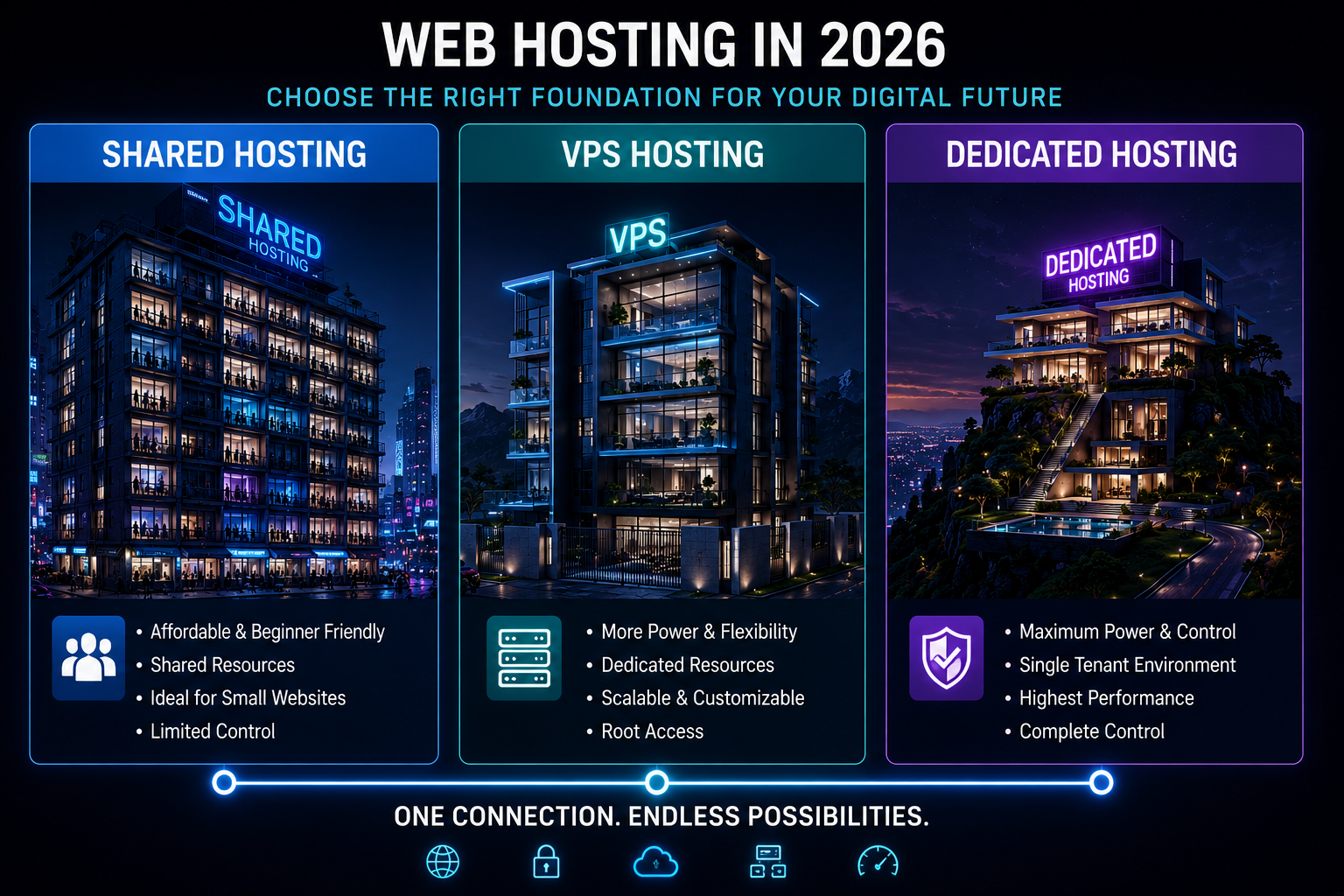
The market offers three primary types of hosting: Shared, VPS (Virtual Private Server), and Dedicated. Each represents a different level of power, control, and cost. Choosing incorrectly can mean overpaying for resources you don’t need or, worse, underpowering your site and losing customers to faster competitors.
Let’s dissect these three options in detail to find the perfect fit for your 2026 goals.
1. Shared Hosting – The “Starter Home”
Shared hosting is the most common entry point into the web hosting world. To use a housing analogy, it’s like living in a large apartment complex. The building belongs to the landlord (the hosting provider), and you rent a small unit. You have your own key (login), but you share the building’s infrastructure—the plumbing, electricity, and internet—with dozens or even hundreds of other tenants.s/
Who is it for? This is the ideal solution for individuals and small businesses who are just starting their digital journey. If you are a freelancer, a local bakery owner, a student launching a personal blog, or a startup testing a minimum viable product (MVP), Shared Hosting is your gateway.
The Pros (Why It’s Popular):
- Unbeatable Price: It is the most affordable option, often costing less than a monthly streaming subscription. This makes it accessible with almost zero financial risk, allowing you to focus your budget on marketing or content creation.
- Incredibly User-Friendly: Shared hosting is designed for the masses. It almost always comes with cPanel or a similar dashboard—a graphical interface that simplifies server management. With just a few clicks, you can install WordPress, set up professional email addresses, manage databases, and handle file transfers. No coding or terminal commands are required.
- Low Maintenance: The web host handles all the heavy lifting. They take care of server maintenance, security patches, hardware upgrades, and basic DDoS protection. You don’t need to be a sysadmin to run a site here; you simply focus on your website’s content.
The Cons (The Hidden Trade-offs):
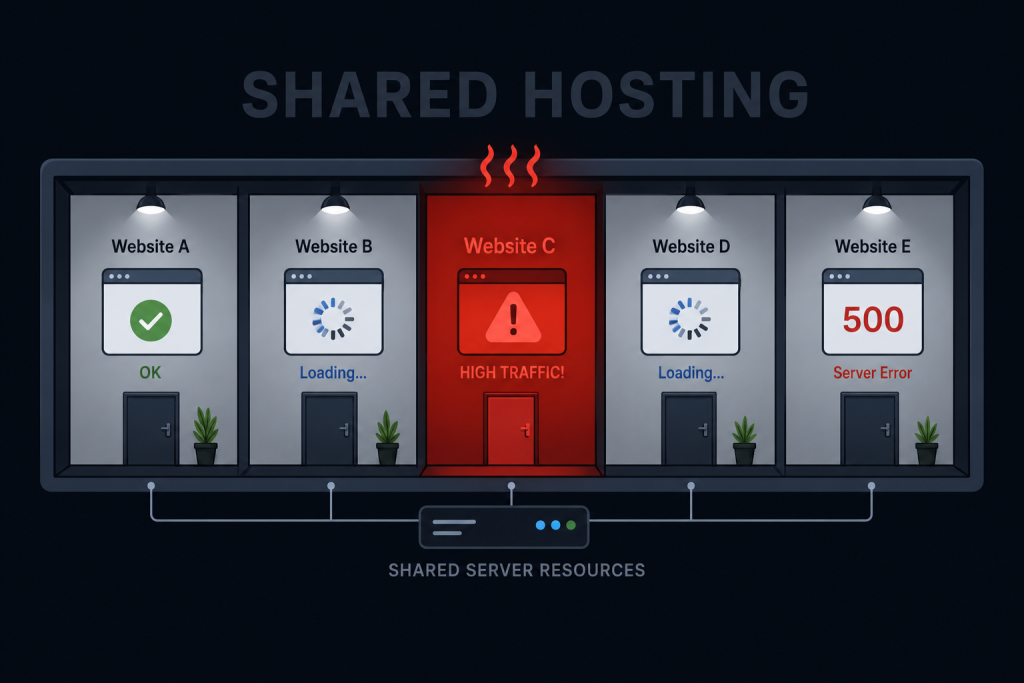
- The “Noisy Neighbor” Problem: This is the single biggest drawback. Since CPU, RAM, and bandwidth are pooled, if one website on your server gets a sudden spike in traffic (like a viral social media post), it will consume the server’s capacity. This will cause your site to slow down, stall, or even crash, even if your own traffic remains normal. Your performance is literally tied to the strangers sharing your server.
- Restricted Scalability: If your business takes off and your traffic doubles or triples, your shared hosting plan will quickly choke. You cannot simply “add more RAM” on the fly; upgrading often requires a tedious migration to a different hosting type, which can involve downtime and technical hurdles.
- Limited Configuration & Security: You are locked into the provider’s environment. You cannot install custom software, specific PHP modules, or adjust core server settings like memory limits or execution times. Furthermore, while basic security is provided, your site is only as secure as the weakest site on the server. If a neighboring site gets hacked, there’s a risk of cross-contamination.
The Verdict: Shared Hosting is a fantastic, low-cost launching pad. It’s perfect for learning the ropes and validating your idea without financial pressure. However, it is a stepping stone, not a final destination. Think of it as training wheels—great for balance, but you’ll want to take them off once you start speeding up.
Here is Part 2 of the blog, covering VPS Hosting in detail. No extra prompts mixed in—just pure content ready to copy.
2. VPS Hosting – The “Private Condo” (Balance of Power & Price)
A Virtual Private Server (VPS) is the logical next step after shared hosting. To continue our housing analogy, if shared hosting is an apartment building, VPS is like owning a condominium. You still share the physical building (the server hardware) with other users, but your unit is completely private. You have your own dedicated walls, your own electrical panel, and your own water heater—no one else can touch or drain your resources.
Technically, a VPS uses virtualization technology to partition a single physical server into multiple isolated virtual servers. Each partition runs its own operating system and has guaranteed, dedicated portions of CPU, RAM, and storage. Unlike shared hosting, where resources are “best effort,” a VPS gives you allocated resources that are reserved exclusively for you.
Who is it for? VPS is the sweet spot for growing businesses, established e-commerce stores, web development agencies, and medium-traffic content sites. If your blog is now getting 10,000+ monthly visitors, or you’re running an online store with 50-100 concurrent shoppers during peak hours, VPS is your ideal match. It’s also the go-to choice for developers who need root access to test custom configurations without the cost of a dedicated server.
The Pros (Why It’s the Golden Middle Ground):
- Guaranteed Performance: Because resources are allocated exclusively to you, the “noisy neighbor” problem completely disappears. A traffic spike on another website on the same physical machine won’t slow you down one bit. Your CPU, RAM, and I/O are yours and yours alone.
- Root Access & Full Control: You get superuser (root) access to your virtual server. This means you can install any software you like (custom PHP extensions, Node.js, Python environments, specific database versions), tweak server configuration files, and optimize the environment exactly to your application’s needs.
- Enhanced Security: Since your VPS is isolated in its own sandbox, you are far less vulnerable to security breaches originating from other users. You can implement custom firewalls, intrusion detection systems, and strict access policies that are impossible on shared hosting.
- Effortless Scalability: Upgrading a VPS is usually seamless. As your traffic grows, you can increase RAM, CPU cores, or storage with a few clicks (or a simple reboot). Most providers offer flexible scaling so you only pay for what you need, when you need it—perfect for seasonal businesses or flash sales.
The Cons (The Challenges to Consider):
- Higher Cost: VPS hosting is noticeably more expensive than shared hosting. While shared plans can cost as little as $3–$10/month, entry-level VPS plans typically start around $20–$30/month and scale upward from there.
- Technical Knowledge Required (Unless Managed): With great power comes great responsibility. An Unmanaged VPS means you are responsible for server setup, security patches, software updates, and troubleshooting. You’ll need to be comfortable with the Linux command line (or Windows Server administration). However, most providers now offer Managed VPS plans, where the host handles server maintenance while you still enjoy dedicated resources—this is highly recommended for non-technical users.
- Resource Ceiling: While VPS is highly scalable, you are still limited by the physical server’s total capacity. If you eventually outgrow the maximum specs of your provider’s VPS tier, you’ll need to consider a dedicated server.
The Verdict: VPS is the perfect “growth engine” for websites that have outgrown shared hosting but aren’t yet ready for enterprise-level infrastructure. It offers the ideal blend of affordability, performance, and control. For 2026, with rising demands for fast load times and complex web applications, VPS has become the baseline standard for any serious online business.
Here is Part 3 – the final section of the blog, covering Dedicated Hosting, the comparison table, and the verdict. I’ve also included the image prompts at the end as you requested.
3. Dedicated Hosting – The “Luxury Villa” (Power & Performance at Its Peak)
Dedicated hosting is the pinnacle of web hosting. To extend our housing analogy, if shared hosting is an apartment and VPS is a condo, dedicated hosting is owning a massive, standalone luxury villa on its own private plot of land. The entire property—the building, the garden, the driveway—is yours and yours alone. No neighbors, no shared walls, no common utilities.
In technical terms, a dedicated server means you are renting (or leasing) an entire physical server from a hosting provider. Every single resource—the CPU cores, the RAM modules, the hard drives, and the network bandwidth—is exclusively dedicated to your website or application. You are not sharing the hardware with anyone else, ever.
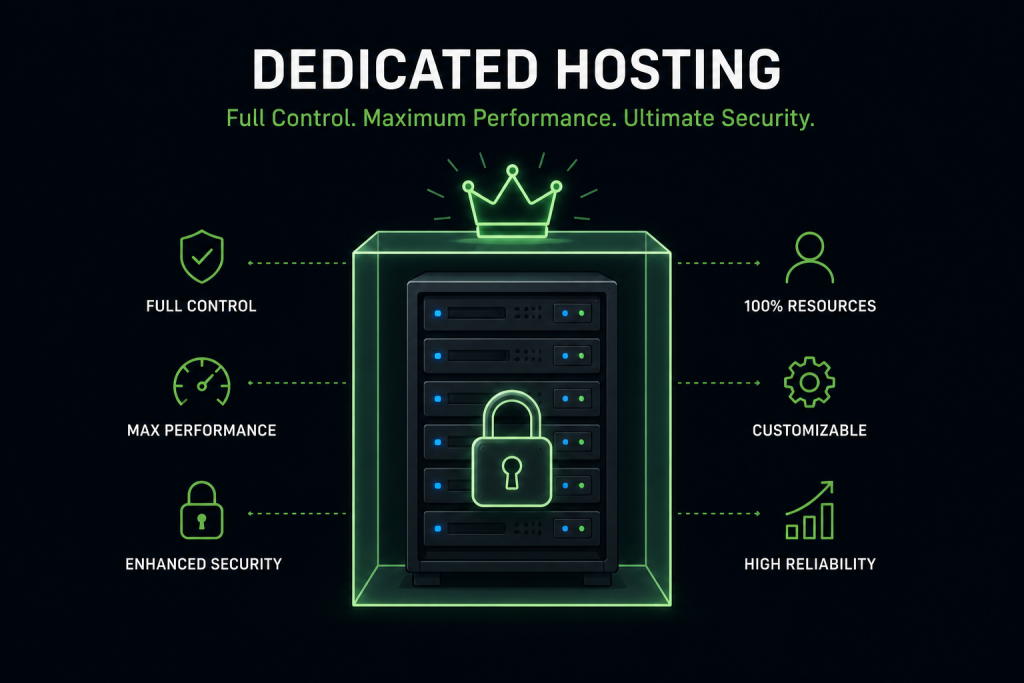
Who is it for? This is the heavyweight champion, reserved for enterprises, high-traffic e-commerce giants, large media publications, SaaS platforms with thousands of concurrent users, and mission-critical applications where downtime is simply not an option. If your website handles millions of monthly visitors, processes sensitive financial transactions, or requires heavy computational power (like AI models or big data analytics), dedicated hosting is non-negotiable.
The Pros (Why It’s the Gold Standard):
- Maximum & Uncontested Performance: You get the full brute force of the server’s hardware. If you lease a server with 32 CPU cores and 128GB of RAM, all of that power is at your disposal 24/7. There is no “resource contention,” no noisy neighbors, and no throttling. Your site will load at lightning speed, even during peak traffic surges. In 2026, with the rise of AI-powered chatbots and dynamic personalization, this raw power is increasingly critical.
- Top-Tier Security & Compliance: Since you are the sole tenant, you have complete control over your security posture. You can implement custom hardware firewalls, advanced DDoS mitigation, intrusion prevention systems, and strict VPN access policies. For businesses subject to compliance regulations like GDPR, HIPAA, or PCI-DSS (for credit card processing), dedicated hosting provides the isolated environment and audit controls required to pass rigorous inspections.
- Ultimate Customization & Root Access: You have full, unrestricted root-level access to the server’s operating system. You can choose your OS (Linux distribution or Windows Server), compile custom kernels, install proprietary software, configure every single service (Apache, Nginx, MySQL, Redis) to your exact specifications, and optimize the entire stack for your unique workload.
- Handles Massive Traffic Loads: Whether it’s a viral product launch, a Super Bowl ad, or a global flash sale, a well-configured dedicated server can handle millions of concurrent requests without breaking a sweat. You are only limited by your network uplink and your own application’s code efficiency.
The Cons (The Price of Power):
- The Most Expensive Option: Dedicated servers come with a premium price tag. Entry-level dedicated plans typically start around $80–$150/month and can easily scale to $500–$1,000+ per month for high-spec enterprise hardware. This is a significant operational expense, not suitable for small budgets.
- Significant Technical Expertise Required: With a dedicated server, you are essentially your own IT department (unless you opt for a Managed Dedicated plan). You are responsible for OS installation, security patching, hardware monitoring, data backups, and troubleshooting. You need a skilled system administrator or a dedicated DevOps team to manage it effectively. Unmanaged dedicated servers are not for beginners.
- Overkill for Small Sites: If you are running a simple blog or a small business site, you will be paying for massive horsepower that you will never use. It’s like buying a freight train to deliver a single letter—inefficient and wasteful.
- Scalability Takes Longer: Scaling a dedicated server usually means a physical hardware upgrade (adding more RAM, swapping CPUs, or adding NVMe drives) or migrating to a newer, more powerful server. Unlike VPS, where scaling is often a click away, hardware upgrades on a dedicated server may require scheduling downtime and manual intervention.
The Verdict: Dedicated hosting delivers uncompromising performance, bulletproof security, and ultimate control. It is the foundation upon which digital empires are built. If your website’s success depends on every millisecond of load time and you cannot afford even a second of downtime, dedicated hosting provides the peace of mind and raw power that no other solution can match.
Quick Comparison Table (2026 Edition)
| Feature | Shared Hosting | VPS Hosting | Dedicated Hosting |
|---|---|---|---|
| Cost | 💰 Low ($3–$15/mo) | 💰💰 Medium ($20–$80/mo) | 💰💰💰 High ($80–$500+/mo) |
| Performance | ⭐ Basic (Shared CPU/RAM) | ⭐⭐ Strong (Guaranteed resources) | ⭐⭐⭐ Top-tier (Exclusive hardware) |
| Security | 🔒 Basic (Shared environment) | 🔒🔒 Good (Isolated environment) | 🔒🔒🔒 Maximum (Full isolation & custom firewalls) |
| Control | ⚙️ Limited (cPanel only) | ⚙️⚙️ Moderate (Root access) | 🛠️ Full (Complete root + hardware control) |
| Scalability | 📈 Poor (Must migrate to upgrade) | 📈📈 Excellent (Click to scale) | 📈📈 Good (Hardware upgrades, may require downtime) |
| Technical Skill | 🟢 None required | 🟡 Some required (or choose Managed VPS) | 🔴 High expertise required (or choose Managed Dedicated) |
| Best For | Beginners, personal blogs, portfolios, MVPs | Growing SMBs, e-commerce stores, developers, agencies | Enterprises, high-traffic apps, SaaS, mission-critical systems |
Final Thoughts: Which One Is Right for You in 2026?
Choosing the right hosting in 2026 isn’t about picking the “best” one—it’s about picking the right one for your specific stage of growth. Here’s a quick decision framework:
- If you are just starting out with a personal blog, a small portfolio, or a side project with minimal traffic, Shared Hosting is your low-risk, budget-friendly starting point. It gets you online quickly and affordably.
- If you have an established business, a growing e-commerce store, or a website with 5,000–50,000 monthly visitors that demands reliable performance and room to grow, VPS Hosting is your golden ticket. It offers the perfect balance of power, price, and flexibility—especially with the rise of managed VPS options that remove technical headaches.
- If you are running a large-scale enterprise, a high-traffic media platform, a financial application, or any mission-critical service where uptime is sacred and speed is a competitive advantage, Dedicated Hosting is the only choice. The investment pays for itself in performance, security, and customer trust.
Remember, hosting is an investment in your business’s future, not just an expense. Skimping on hosting is like building a beautiful storefront on a crumbling foundation—eventually, it will collapse under its own weight.
Ready to make the right choice for your 2026 goals?
At Geek Crunch Hosting, we offer fully optimized Shared, VPS, and Dedicated Hosting plans built on next-gen hardware, with SSD storage, 99.99% uptime guarantees, and 24/7 expert support. Whether you’re just starting out or scaling to the moon, we have a solution tailored for you.