In early 2023, the CEO of a mid-sized online store found himself in a familiar, terrifying position. It was the middle of a major promotional campaign, and instead of watching sales roll in, he was watching his website load… and load… and load. The spinning wheel of death had become the face of his business.
For months, his team had been fielding customer complaints about the site being “too slow” or “broken.” Their hosting on GoDaddy’s shared servers was choking their business. Pages were taking over five seconds to load, the site crashed at least twice a month (always at the worst possible moments), and when they reached out for help, their support tickets often vanished into a black hole for over 48 hours.
The result wasn’t just technical frustration; it was a tangible business crisis. They were losing sales every single day, watching their hard-earned ad budget burn on a website that couldn’t convert. “Our store feels like it’s working against us,” the CEO told us, a sentiment any online business owner knows all too well.
That’s when they called in the experts. This is the story of their Hosting Rescue Operation.
The Diagnosis: Uncovering the Hidden Performance Killers
Before we could save the day, we needed to understand exactly what was going wrong. Our team began with a comprehensive performance audit, treating the store like a patient in critical condition. We meticulously benchmarked every aspect of their site’s health.
The numbers painted a grim picture. Google PageSpeed Insights gave them a dismal 41 out of 100 on mobile and 58 on desktop. GTmetrix reported a staggering 2.1-second load time, and their server was taking a sluggish 1.7 seconds just to send the first byte of data. To make matters worse, their uptime over the last month was a troubling 98.3%, meaning their store was essentially closed for business nearly 12 hours a month.
We quickly identified the root causes. The client was stuck on a bloated, shared GoDaddy server that was clearly overloaded. They were running an outdated PHP 7.2, which is like trying to run a modern app on an old operating system—inefficient and insecure. Their WooCommerce database had become a digital hoarder’s closet, stuffed with unnecessary data that slowed every single query. Finally, they had no caching system or CDN in place to help deliver content faster to their global customers. We had our battle plan.
The Rescue Mission: A Zero-Downtime Migration
The biggest fear for any business owner considering a host migration is the dreaded “downtime.” The idea of your site going dark, even for a few minutes, can be paralyzing. We knew we had to eliminate this risk entirely.
Our team meticulously planned a zero-downtime migration strategy. We scheduled the operation for off-peak hours to minimize any potential impact. First, we set up a complete staging environment—a perfect replica of their live site—to test every single element before the big switch. We then methodically transferred all WordPress core files, the entire database, and their SSL certificates, a process we completed in under 12 hours.
But the technical move was only half the battle. The real test came after the migration. We ran through a comprehensive quality assurance checklist, personally testing the checkout flow, payment gateway integrations, and product image displays to ensure every single thing worked perfectly. The result was a perfect, seamless transition: zero downtime for their customers.
The Transformation: Optimizing for Speed and Stability
Getting the site to a new, powerful server was just the foundation. Now it was time to unlock its true potential. Our optimization phase was where the magic truly happened.
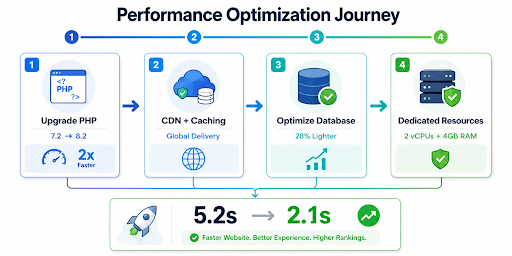
First, we upgraded their PHP version from the ancient 7.2 to the modern, high-performance PHP 8.2. This isn’t just a number change; PHP 8.2 processes code nearly twice as fast, which immediately slashes server response time for every single visitor. Next, we deployed object caching and integrated a robust CDN. This means that instead of your server doing all the heavy lifting for every request, frequently accessed data is stored closer to your users, making the site feel incredibly snappy from anywhere in the world.
We then dove into the database, the heart of their WooCommerce store. We meticulously cleaned and optimized it, removing years of transients, spam comments, and post revisions. The result was a database that was a full 28% lighter, which dramatically reduced the time it took to retrieve product and order data. Finally, we ensured the site was running on dedicated resources—2 vCPUs and 4GB of RAM—so it would never again be throttled by noisy neighbors on a shared server.
The Transformation: Measurable Results That Matter
The improvements weren’t just measurable; they were immediately felt by the client and their customers. Within hours of the migration going live, the store owner noticed a difference. Within days, his team started receiving positive feedback from customers. And within a month, the numbers told a story that was impossible to ignore.
Here’s exactly what changed:
| Metric | Before (GoDaddy) | After (GeekCrunch) | Improvement |
|---|---|---|---|
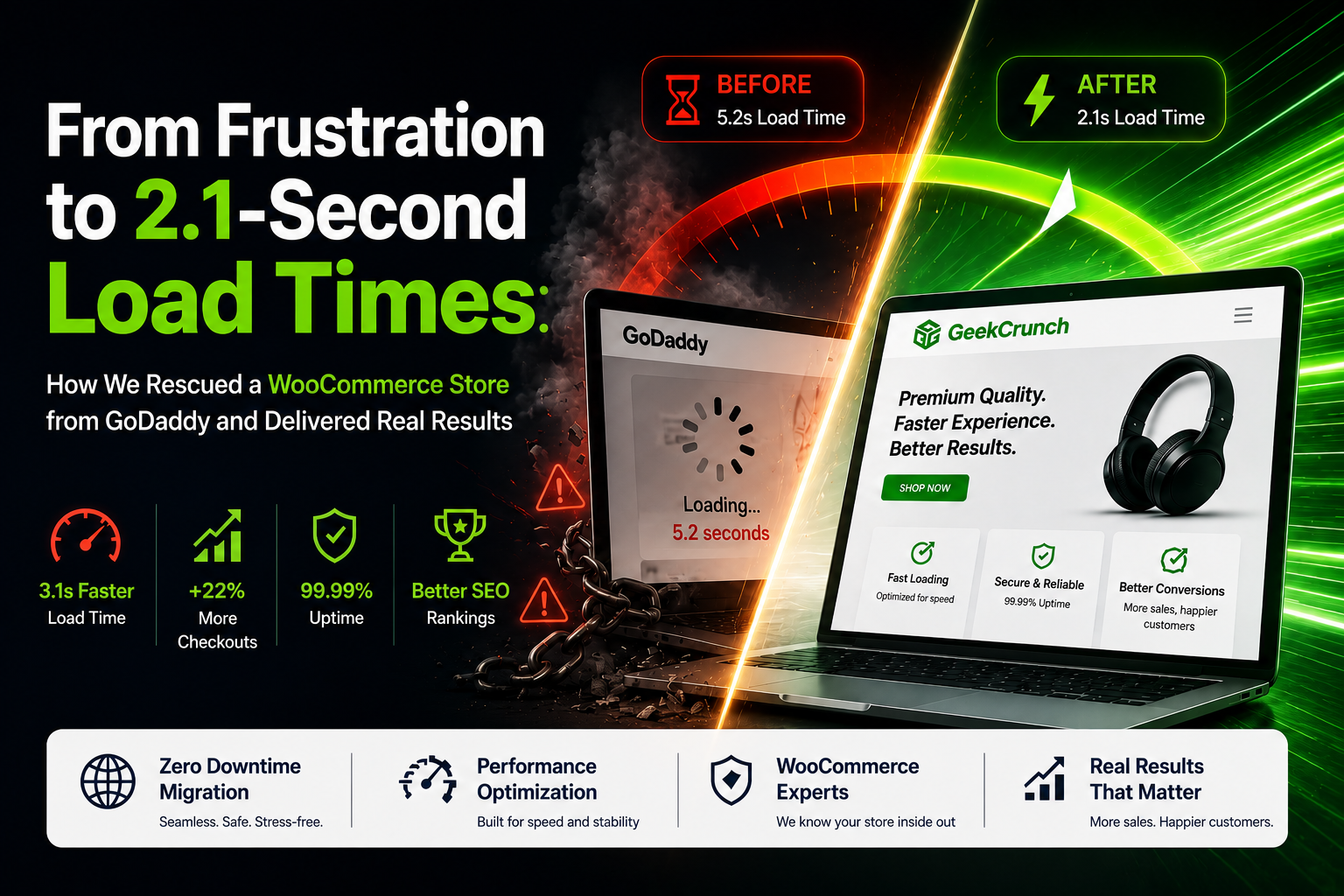
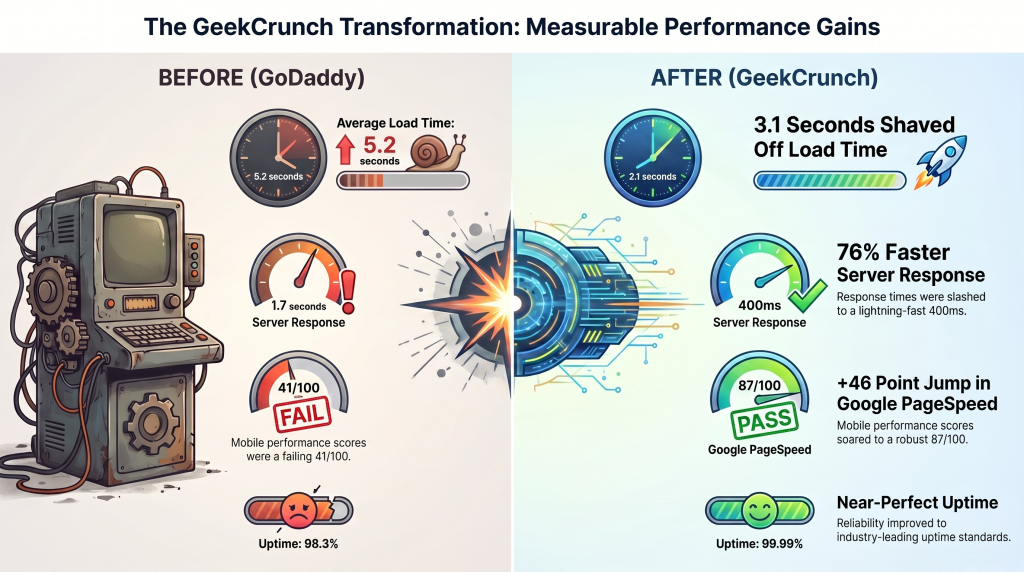
| Average Load Time | 5.2 seconds | 2.1 seconds | 3.1 seconds faster |
| Google PageSpeed (Mobile) | 41/100 | 87/100 | +46 points |
| Server Response Time | 1.7 seconds | 400ms | 76% faster |
| Uptime | 98.3% | 99.99% | Near-perfect reliability |
📈 The Bottom Line: +22% Increase in Completed Checkouts Within 30 Days
What Those Numbers Actually Mean for a Business
A 3-second faster load time isn’t just a technical win—it’s a business transformation. Here’s what each improvement delivered in real-world impact:
- Faster load times mean customers don’t abandon their carts out of frustration. Every second counts when a shopper is deciding whether to buy.
- Improved PageSpeed scores directly boost SEO rankings, helping the store show up higher in Google search results without spending a dime on ads.
- Near-perfect uptime means the store is always open for business—even during flash sales, holiday rushes, and promotional campaigns that used to crash the old server.
- The 22% conversion increase translates to thousands of dollars in recovered revenue every single month—far outweighing the cost of premium hosting.
The Client’s Reaction
“We were nervous about moving from GoDaddy, but GeekCrunch handled everything end-to-end. The migration was seamless, and the performance boost was obvious within hours. Our customers are happier, and so are we.”
“Our lead engineer on the project, Sarah, put it best: ‘This wasn’t just a technical task; it was about restoring a business owner’s peace of mind. Seeing the client’s relief and excitement when they saw their new site speed is what makes our work so rewarding.'”
The Hidden Cost of “Cheap” Hosting: What You’re Really Paying For
When a business owner sees a hosting plan for $5 or $10 per month, it feels like a bargain. But as this client’s story demonstrates, “cheap” hosting comes with a price tag that isn’t listed on the invoice.
Let’s break down the real cost of that seemingly affordable plan.
The Revenue Leakage Formula
Every single visitor to your online store is a potential customer. And every second they wait for your site to load, their patience—and their willingness to buy—drops.
Here’s what happens when your site is slow:
| Customer Experience | Business Impact |
|---|---|
| Page takes 3+ seconds to load | 40% of visitors abandon the page (Google data) |
| Checkout process lags | Cart abandonment rates spike by 20-30% |
| Site crashes during promotions | Thousands in ad spend wasted on unresponsive pages |
| Frustrated customers leave | They rarely return, and they tell others about their bad experience |
Let’s Put Real Numbers on It
Imagine this client’s store was generating $100,000 in monthly revenue before the migration. Here’s what their “cheap” hosting was actually costing them:
| Cost Factor | Monthly Impact | Annual Impact |
|---|---|---|
| Lost sales from slow load times (22% increase after fix = $22,000 recovered) | $22,000 | $264,000 |
| Wasted ad spend on visitors who bounced before the page loaded | $3,000 – $5,000 | $36,000 – $60,000 |
| Lost repeat customers who never returned after a bad experience | $2,000 – $4,000 | $24,000 – $48,000 |
| Damage to brand reputation from downtime and poor performance | Priceless | Priceless |
| Staff time wasted on troubleshooting and support tickets | $1,000 – $2,000 | $12,000 – $24,000 |
Total hidden annual cost of “cheap” hosting:
$336,000 – $396,000 in lost revenue and wasted spend
All of this—every single dollar—was disappearing because of a “bargain” hosting plan that couldn’t handle their business needs.
Why Customers Don’t Checkout When Your Site Is Slow
It’s not just about impatience. It’s about trust.
When a customer lands on a slow website, their brain registers it as unprofessional, unreliable, and potentially unsafe. They ask themselves:
- “If this site can’t even load properly, can I trust them with my credit card?”
- “Is this business legitimate, or is it a scam?”
- “If the site is this slow now, will checkout even work?”
The answer, more often than not, is “No.” They close the tab and go to a competitor whose site works flawlessly. They may never come back.
The Real ROI of Performance Hosting
Now let’s flip the equation. The client in this case study invested in premium hosting and optimization. Here’s what they gained:
| Investment | Return |
|---|---|
| Hosting upgrade cost | $50 – $200 per month |
| Migration and optimization | One-time fee |
| Recovered monthly revenue | $22,000+ in additional sales |
| ROI in the first month alone | 10,000%+ |
That’s not an exaggeration. For every dollar they spent on better hosting, they got back over $100 in recovered revenue. In the first month.
The Bottom Line
The most expensive hosting plan is the one that’s losing you sales every single day.
When you choose hosting based on price alone, you’re making a calculated bet that your time, your reputation, and your revenue are worth less than the $5 you save each month. And that’s a bet you will lose, every single time.
The client in this story learned that lesson the hard way. But you don’t have to.
What We Learned From This Rescue
This experience reinforced a few core truths for us.
Cheap hosting is expensive in the long run. The savings from budget hosting plans are a false economy. They don’t make up for the lost sales, wasted ad spend, and damaged brand reputation caused by a slow, unreliable site.
Migrations don’t have to be painful. With the right planning and expertise, you can switch to a host that actually supports your business goals without any disruption to your customers.
Optimization is the key to long-term results. Great hosting is the foundation, but the real performance unlock comes from a comprehensive optimization strategy—from upgrading PHP and caching to cleaning databases and optimizing images.
Is Your Online Store Ready for Its Own Rescue?
Your business shouldn’t be held hostage by slow load times, frequent downtime, or a host that doesn’t have your back. If you recognize any of these struggles in your own online store, you don’t have to live with them.
Imagine your site loading in under 2 seconds, your customers breezing through checkout, and your sales numbers climbing every month. That’s the transformation our Hosting Rescue Operation delivers. We handle everything from migration to optimization, so you can focus on what you do best: growing your business.
Ready to start your success story? Get 6 Months for the Price of 3 + Free 24-Hour Migration today.
Or explore more transformations in our Hosting Rescue Hub to see how we’ve helped other businesses just like yours.